Key Takeaways
-
Pool demolition permit fees are set by each city or county, not the state, so there is no single national price. Call your local building department for the current fee schedule at your address.
-
Official examples vary widely: Elk Grove, CA lists a $250 flat fee, Frisco, TX lists $50, and San Diego totals $692.84 in plan-check and inspection fees.
-
Your pool type and removal method affect permit requirements. Full removal is often cleaner for future building, while partial removal may bring extra rules if you build on the site later.
-
Ask whether plan review and inspections are included in the base fee, since some jurisdictions bill them separately from the permit itself.
-
Engineering reports, compaction testing, and separate utility disconnect permits for gas, electric, or water are often billed apart from the main permit fee and can add significant cost.
-
Submit a complete application with a site plan, drainage details, and any required engineering reports to avoid review delays and extra expenses.
So you’re ready to say goodbye to your backyard pool. Maybe it leaks. Maybe nobody swims anymore. Maybe you just want your yard back. Whatever the reason, the first question most people ask is about the pool demolition permit cost. It’s a smart question, and the honest answer might surprise you.
There is no single national price. Each city and county sets its own fees and rules. Some places charge a small flat fee. Others split the cost into plan review and inspection charges. Because of that, the smartest move is to learn what drives the permit side of your project before you pick up the phone.
In this friendly guide, we’ll walk you through six things that shape your permit costs in 2026. Whether you’re a homeowner, a property manager, a contractor, or a developer in Clark or Nye County, you’ll find clear steps and helpful tips. Let’s dig in.

1. Your Local Jurisdiction Sets the Fee
Here’s the big one. Permit fees are set locally, not by the state or the nation. The same pool removal can have very different permit costs depending on where the property sits.
Official city sources show just how wide the range can be:
- Elk Grove, California: lists a flat $250 fee for residential pool and spa demolition.
- Frisco, Texas: lists a $50 swimming pool demolition fee on its schedule effective October 1, 2026.
- San Diego, California: lists a $360.36 plan-check fee plus a $332.48 inspection fee, which adds up to $692.84.
These are only examples from other cities. They are not quotes for Nevada, and they are not directly comparable. Each place defines its fees in its own way. For a real answer, check with the building department that covers your property.
In Southern Nevada, that usually means the city or county office. You can start with the Clark County Building Department or review the Las Vegas demolition permit guidelines if your property is inside city limits. For a deeper look at local rules, see our post on pool demolition regulations Nevada owners must know.
2. The Type of Pool You Have
Not every pool needs the same paperwork. The kind of pool you own can change what the city asks for.
In-Ground Pools
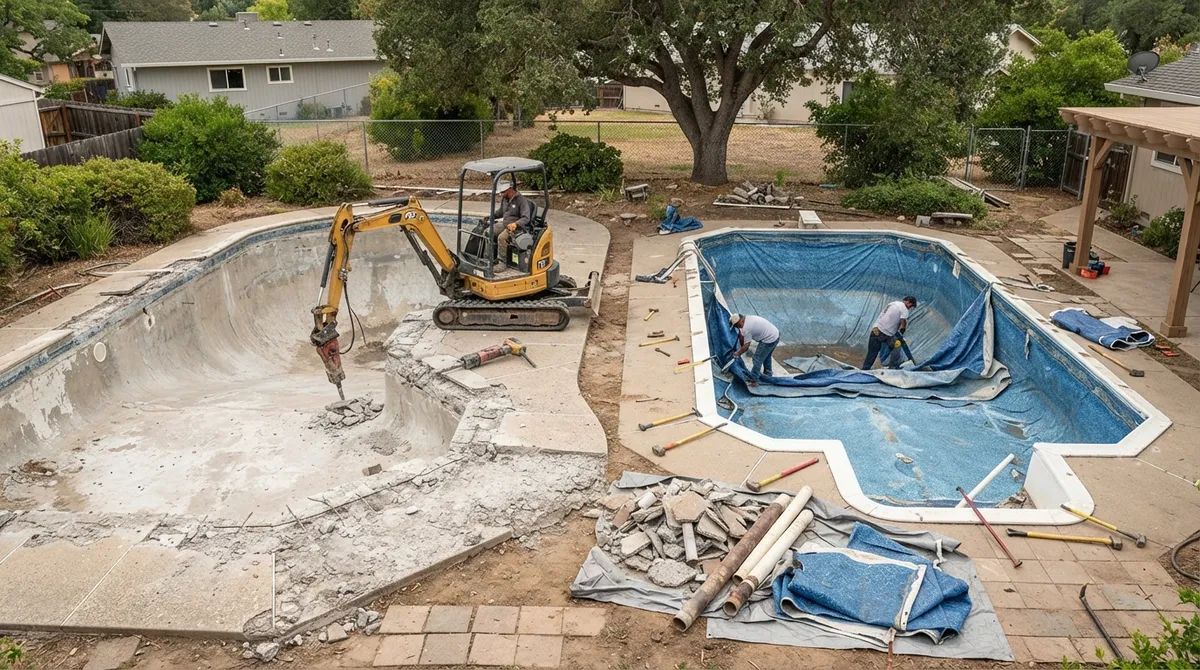
A permit is commonly required before you remove or abandon an in-ground pool. These projects involve digging, breaking up the shell, hauling debris, and filling the hole. Because the work changes the ground itself, cities pay close attention.
Above-Ground Pools and Spas
Rules for above-ground pools, hot tubs, and spas can be different. Some places want a permit. Others may not. Always confirm before you start. Our guides on above ground pool demolition and hot tub and spa removal can help you plan.
Special Property Status
Historic or specially designated properties may have extra rules. If your home falls into one of these groups, ask the building department early so there are no surprises.
| Pool Type | Permit Usually Needed? | Extra Items to Ask About |
|---|---|---|
| In-ground concrete or gunite | Commonly yes | Fill method, compaction, inspections |
| In-ground fiberglass | Commonly yes | Shell removal, backfill, grading |
| Above-ground pool | Varies by location | Electrical and deck removal |
| Spa or hot tub | Varies by location | Utility disconnects |
3. The Paperwork Your Application Needs
Part of your permit cost is really the work of getting your documents ready. Many jurisdictions ask for a clear set of plans before they approve anything.
Here’s what an application may include:
- A site or plot plan showing the pool, property lines, nearby structures, and the planned work.
- A description of the demolition method, such as partial or full removal.
- Drainage and erosion-control details so water does not cause problems during or after the project.
- An engineering or geotechnical report if the city requires one.
- A compaction plan when the area may be built on later.
The more complete your submission, the smoother the review. Missing items can slow things down and may lead to extra review time. A good contractor can help you pull these pieces together. If you want to see how permits fit into a bigger demolition plan, take a look at 9 demolition permit services you need in 2026.
4. The Removal Method You Choose
How you remove the pool changes what the city expects. This is one of the most overlooked parts of the process.
Some jurisdictions allow the shell to stay in place if it is punctured or partly broken and then properly backfilled. Others require more of the shell to come out. Some even name specific removal depths and drainage openings.
Partial Removal
With partial removal, the top portion of the pool is broken up and the rest stays buried. The shell is opened so water can drain through. This is often quicker, but it may lead to extra rules if you plan to build on that spot later.
Full Removal
With full removal, the whole pool structure is taken out and hauled away. The hole is then filled and compacted. This is the cleanest option for future building, and it often makes final approval simpler.
Not sure which path fits your yard? Our guides on full pool removal steps and permits and concrete pool demolition break it down in plain language.
5. Inspections and Testing Add to the Picture
Permits are not just a form and a fee. They usually come with inspections, and those can shape your total project budget.
Common inspection points include:
- Before backfilling: an inspector checks that the pool has been opened or removed the right way.
- After grading: the city confirms the final surface meets the approved plan.
- Compaction testing: required in some places when the area may hold a future structure.
Where the pool area may be built on later, some cities want engineered fill, compaction tests, or a geotechnical report before final sign-off. Those items can be separate from the permit fee itself. Learn more about what to expect in what inspections a pool demolition requires.
Here’s a simple way to think about the timeline:
- Submit your plans and apply for the permit.
- Wait for plan review and approval.
- Disconnect utilities and drain the pool safely.
- Complete the demolition work.
- Pass the pre-backfill inspection.
- Fill, compact, and grade the area.
- Pass the final inspection and close the permit.
Skipping a step can mean redoing work, so patience here pays off. See the full flow in 8 steps in the pool demolition process.
6. Costs Beyond the Permit Fee
This is where many owners get caught off guard. The permit fee is only one slice of the pie. A project can include several other items, and each one may or may not be covered by the local fee schedule.
| Possible Item | What It Covers | Included in Permit Fee? |
|---|---|---|
| Plan review | City checks your submitted plans | Varies by jurisdiction |
| Inspections | Field visits before and after work | Varies by jurisdiction |
| Engineering or geotech report | Soil and fill documentation | Usually separate |
| Compaction testing | Proof the fill is dense enough | Usually separate |
| Utility disconnection | Gas, electric, or water lines | Often separate permits |
| Water discharge approval | Safe draining of pool water | May require approval |
| Deposits | Held by the city until close-out | Varies |
| Demolition and hauling | The actual removal work | No, paid to the contractor |
Don’t forget the utility side. Pool pumps, heaters, and lighting often connect to gas and electric lines, and those may need their own sign-off. Our guide to utility disconnect steps for pool removal walks through what to expect.
How a Pro Makes the Permit Process Easier
Dealing with permits can feel like a maze. Forms, plans, inspection dates, and rules that change from one office to the next. That’s where an experienced local team really helps.
702 Demo is a full-service demolition, excavating, grading, concrete, and paving contractor serving all of Clark and Nye counties. We know the local process, and we believe we’re the best demolition contractor in Las Vegas for pool projects of every size. Our crew handles the demolition, the hauling, and the grading, so the whole job flows together.
Want to see what other neighbors think? You can visit us on Google — 702 Demo and read reviews from real customers. You can also explore our pool removal services to see how we handle each phase.
Who Benefits Most From Planning Ahead?
- Homeowners who want a clear budget and no surprise delays.
- Renovation contractors who need the pool gone before foundation or landscape work begins.
- Property managers dealing with unused or unsafe pools on multi-family or commercial sites.
- Developers and commercial builders who must clear and grade a site on a tight schedule.
If you’re coordinating a larger site, you may also like how to plan swimming pool removal the right way. And for a wider look at cost drivers, read our post on pool demolition cost factors homeowners face.
A Quick Checklist Before You Apply
Keep this short list handy. It can save you time and stress.
- Confirm which building department covers your address.
- Ask for the current fee schedule and the written requirements.
- Ask whether plan review and inspections are included in the base fee.
- Find out if an engineer’s report or compaction testing is required.
- Check for separate permits for gas, electric, and water.
- Confirm the allowed removal method and any depth rules.
- Plan for how pool water will be drained and discharged.
Prefer to read more? Our 8 pool demolition permit facts to know in 2026 is a great next step.
Final Thoughts
The pool demolition permit cost is not a one-size-fits-all number. It depends on your local rules, your pool type, your removal method, and the inspections your project needs. The permit fee is only part of the story, so always plan for the full picture.
The best way to protect your time and peace of mind is to work with a team that knows Southern Nevada inside and out. When you’re ready to move forward, contact 702 Demo for a free estimate and let us help you take the first step. We’ll answer your questions, guide you through the process, and get your yard ready for its next chapter.
FAQs
Q: How much does a pool demolition permit cost?
A: There is no single price, because each city and county sets its own fees. Official examples from other cities range from a $50 flat fee to a few hundred dollars in separate plan-check and inspection charges. Call your local building department to get the current number for your address.
Q: Do I need a permit to fill in or remove my pool?
A: In most places, yes. A permit is commonly required before you remove or abandon an in-ground pool. Rules for above-ground pools and spas can differ, so it’s always best to confirm with your local office before any work begins.
Q: What documents do I need for a pool demolition permit?
A: You’ll often need a site or plot plan showing the pool, property lines, and nearby structures. Some areas also ask for drainage details, an engineering or geotechnical report, or a compaction plan. Your contractor can help you gather everything.
Q: Does the permit fee cover inspections?
A: It depends on the jurisdiction. Some cities bundle plan review and inspections into one fee, while others list them separately. Ask for the full fee schedule so you know exactly what’s included.
Q: Do I need soil compaction testing when filling in a pool?
A: Sometimes. If the area may be built on later, many jurisdictions require engineered fill, compaction testing, or a geotechnical report before final approval. Check with your local building department to see what applies to your project.